
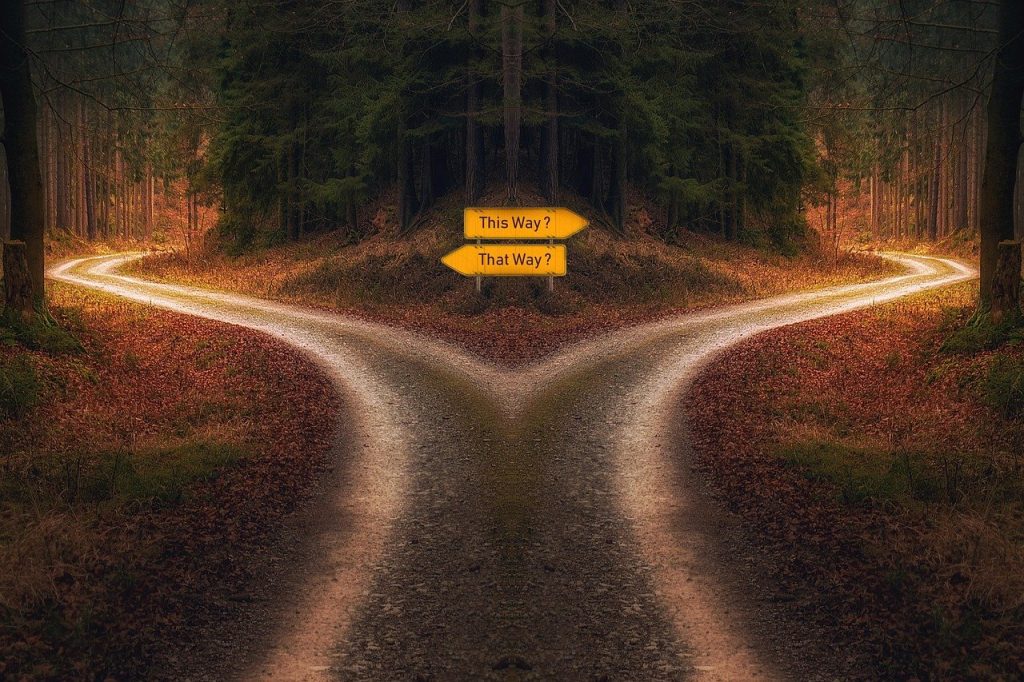
Every "if" is secretly a "when", and every "when" is secretly an "if" — nothing that can happen is impossible, and nothing you count on is guaranteed
Your mind runs a filing system with two drawers. Into the first drawer, marked "if", go the maybes — the illness, the loss, the failure, everything you hope will pass you by. Into the second, marked "when", go the certainties — the retirement, the wedding, the quiet years you have been promised by nobody in particular. The entire architecture of your inner life rests on those two labels, and you consult them all day long: this one is only an "if", so I may relax — that one is a "when", so I may lean on it.
This piece is here to tell you that the drawers are mislabelled — both of them, in both directions. Every "if" is secretly a "when": nothing that can happen is impossible, so the dreaded outcome you keep theoretical belongs to a real timeline. And every "when" is secretly an "if": nothing you count on is guaranteed, so the future you lean on is leaning on nothing. That sounds, at first hearing, like bad news twice over. Stay with me — by the end it will read as the most calming sentence you have heard in years, and your anxiety, of all your visitors, will be the one most relieved.
Anxiety runs on exactly one trick — the 3am "what if" torments you by quietly promoting a mere possibility into a done deal
Begin at 3am, because that is where the mislabelling does its worst work. You wake, and the mind presents its case: the odd symptom, the unanswered message, the payment that might not come through. Each one enters the room as a "what if" — and then, while you are too tired to watch the paperwork, the promotion happens. What if I am ill becomes I am probably ill becomes, by 4am, a done deal that merely has not been announced yet. You are no longer worrying about a possibility. You are grieving a certainty that does not exist.
And notice — the panic needs that promotion. A merely possible catastrophe cannot keep you awake for long: the mind slides off it, the body stays soft, the eyes close. To hold you hostage, the fear must present itself as settled — signed, sealed, already on its way. Anxiety, examined closely, is not too much uncertainty. It is counterfeit certainty about the worst.
Your plans run the same trick in reverse — "when I retire", "when life settles", "when this is over" speak of a future that nobody has promised you
Daylight brings the mirror image, and it looks so respectable that you have never once called it by its name. "When I retire, I will finally rest." "When life settles, I will travel." "When this project is over, the real living starts." Listen to the grammar: every one of those sentences treats an unpromised future as a done deal — the same promotion as 3am, run on hope instead of dread. You already know where this deferral leads, because you live inside it — you endure most of your days on the way to the few hours you actually enjoy — and the enjoyed hours keep receding.
Ask the only honest question: who signed this? Nobody promised you the retirement, the settling, the after. The calendar you are banking on is a hope wearing a timetable. This is not said to frighten you — it is said to wake you, because a life postponed towards an unguaranteed "when" is being paid for with the one currency you certainly have: the present.
In theory, probability stretches from zero to one — in real life, no event ever touches either end, so the impossible and the certain are both fictions
Underneath both tricks runs one clean law, and you can state it in a single line. In theory, probability stretches from zero to one. In real life, nothing ever touches the ends. Zero would mean an event so impossible that reality has closed the door on it — and reality closes no doors. One would mean an outcome so certain that the universe has already signed for it — and the universe signs for nothing in advance. Zero and one are the mind's round numbers: tidy, restful, and vacant. Nothing has ever actually happened at either address.
Which means everything real — your fears, your plans, your diagnosis, your wedding, tomorrow's weather and tomorrow itself — lives in the open middle, somewhere between the poles, uncommitted. The open middle is not a defect in your knowledge that better information will one day repair. It is where reality itself resides. "If" and "when" pretend to divide the world between the two ends. The world, meanwhile, has never lived at either.
History has never respected either — the "impossible" happens all the time, and sooner or later even the firmest "guarantee" breaks
If the law sounds abstract, history has been demonstrating it without pause. Nassim Taleb built an entire body of work on exactly this — the events that shape everything are the ones the experts had filed under impossible — the crashes, the collapses, the inventions and pandemics that were unthinkable on Monday and inevitable-in-hindsight by Friday. His most famous creature is the turkey: fed generously for a thousand days, its confidence in the farmer rising with every meal, its certainty peaking on the very morning the axe comes. The turkey had a thousand data points and a spotless "when". It lacked only the one that mattered.
And the ledger runs just as long on the other side. The guaranteed pensions that evaporated, the unsinkable ship, the marriages and empires and currencies that carried lifetime warranties — sooner or later even the firmest "guarantee" breaks, and it rarely sends notice ahead. None of this is exotic. Some of it is in your own biography already: something you once filed under impossible has happened to you, and something you once counted as certain never showed up. You are not reading a theory. You are reading your own record.
Even with death — as near to a pure "when" as it gets — you soften the sentence to "if something happens to me"
Now put the flinch under the light, because you have produced it yourself. Death is as near to a pure "when" as it gets — the one appointment written into the terms of being born — yet watch what the mouth does with it: "if something happens to me". Two dodges in six words. The event gets blurred into "something", since the real word will not pass the lips — and the surest "when" there is gets demoted into an "if". The mind that promotes imaginary catastrophes to certainties at 3am spends its days demoting the one near-certainty into a hypothesis.
There is no need to dwell here long — this post is not about dying, and neither is the sentence. But the flinch is worth seeing once, clearly, for what it re-prices. A person who quietly restores that one "when" to its drawer stops treating their days as a rehearsal stock that never runs out. Nothing morbid follows. What follows, for most who do it, is the opposite: the ordinary afternoon stops being disposable — because its supply, whatever its size, was never guaranteed to be large.

And exactly here your fear dissolves — you see that the event you dreaded was a possibility all along, and only your mind ever called it a certainty
Now carry all of this back to 3am, because this is where it pays. The next time the fear presents its done deal, something new can happen: you can watch the paperwork. You can see, in real time, that the certainty was self-issued — that no one outside your own mind ever signed it — and that the event you dreaded was a possibility all along, sitting in the open middle with everything else. The moment you see the promotion happen, it stops working, the way a card trick stops working the instant you spot the palm. And exactly here your fear dissolves — not because the possibility went away, but because the false certainty did, and the false certainty was the part that had you by the throat.
What remains is the honest residue: yes, it could happen. And here is the quiet second mercy, standing behind the first. If it ever does come, it will find you equal to it — no demand is made unto you that you cannot fulfil. The possible does not need your dread. It only ever needed your acknowledgement — and acknowledged possibility, unlike counterfeit certainty, lets you sleep.
So whenever you hear yourself say "surely" or "never", ignore them — both of these words claim a knowledge that no one could ever have
The practice, then, is small and quite strict. Whenever you hear yourself say "surely" or "never" — surely this will fail, surely they will leave, never will I manage that, never could that touch me — do not argue with the words, and do not correct them into better forecasts. Ignore them. Arguing keeps you at the mind's table, playing its game with its dice. Ignoring simply declines the hand. Both of these words claim a knowledge that no one could ever have — your mind will keep printing them anyway — printing is its trade — and you are under no obligation to buy.
And be clear about what this practice is not, because there is a cheap version to avoid. You still make plans. You still buy the insurance, book the check-up, save for the retirement you hope to see. Prudence never required certainty — it only required care. What falls away is the worship: the leaning of your whole weight on a "when" that nobody signed, and the surrender of your whole night to an "if" dressed up as fate. You act inside the open middle, exactly as you always did. You just stop pretending it has ends.
Some nights I still fall for the dreaded "if" and the promised "when" — and then I remember that both live in the future, and I do not
I would be lying if I told you I have corrected my own filing system once and for all. Some nights I still fall for the dreaded "if" — my mind issues its counterfeit certainties with the same confidence as ever, and I lie there half-asleep, grieving events that have never happened and probably never will. And some mornings I still lean on the promised "when", planning my calm around a future that nobody has signed. The printer does not stop just because I have written about the printing.
But then the remembering comes, and it is always the same one: "if" and "when" both live in the future — and I do not. I live here, in the one place the two words cannot reach, where nothing is happening except this night, this breath, this bed. That is the ground I return to, and the ground I write all of this from. What stands open for you there carries no date at all — it is an undated invitation, and it does not expire. There is no difference between "if" and "when". There is a difference — all the difference — between the future and now.