
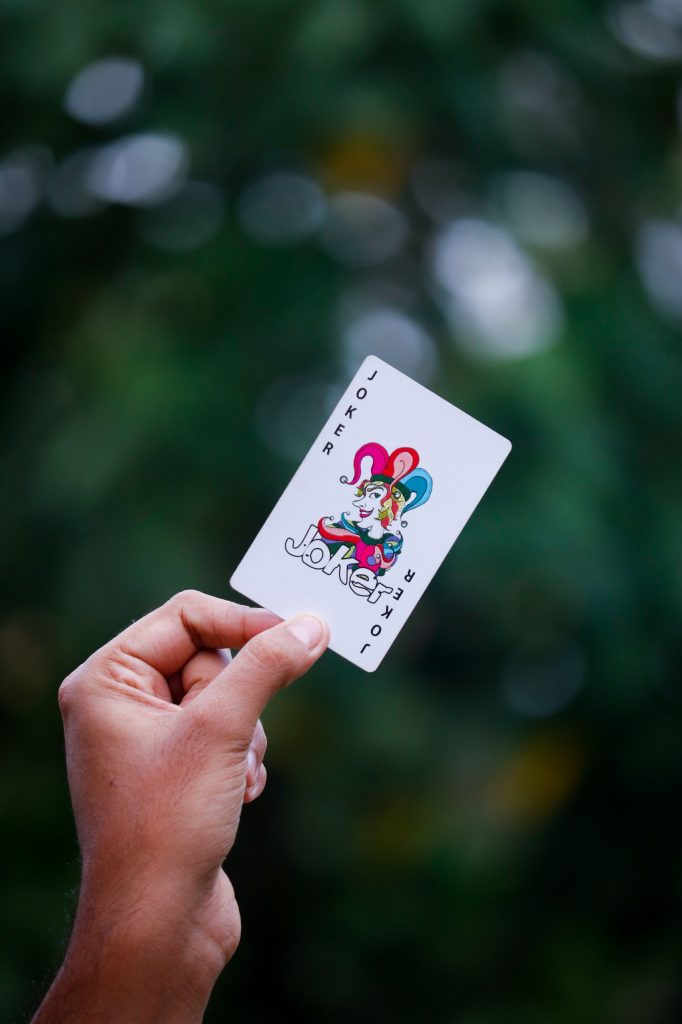
There are only two seats at life's table — either you see the joke, or you are it — and your seat can change anytime, all the time
Life sets its table with exactly two seats, and there has never been a third. In the first seat sits the one the joke is played on: earnest, burdened, gripping the script, certain that everything rides on the next scene. In the second sits the one who got the joke: just as much inside the play, dealt the same cards, wet in the same rain — and lit from within by the seeing of it. No spectator box exists. No neutral chair on the balcony. Whenever you are not seeing the joke, you are performing it.
The headline's second clause deserves its full weight, because it removes every excuse and every laurel at once: neither seat is ever granted for good. Nobody graduates permanently to the second chair, and the first chair never keeps anyone for life. You will cross that table a thousand times before dinner is over — and the entire art, if it can even be called an art, is noticing which side of the table you occupy right now.
Most days you live as the joke — rehearsing arguments in the shower, managing your image, treating the day as a verdict on your existence
Be honest about the first seat, because you occupy it with distinction. You rehearse arguments in the shower against opponents who are not there — and win. You manage your image the way a minister manages a crisis: the right phrase prepared, the right face selected before the door opens, the laugh calibrated to the room. You replay the conversation on the drive home, redrafting one sentence for hours. You treat an unanswered message as a tribunal, a colleague's tone as a prophecy, an ordinary Tuesday as a verdict on your existence.
None of this makes you unusual — it makes you a member in good standing of the human race. The entire species lives like this: billions of creatures on a spinning rock, each one convinced of being the lead actor, each one certain the reviews are being written tonight. Seen from one inch inside, it is agony. Seen from one step outside, it has always been — and here the word must be said with love — funny.
Nothing about your life is the comedy — the comedy is the deadly seriousness with which you take every hour of it
Draw the line precisely, because the difference decides everything. Your life is not ridiculous. Your work matters, your loves are real, your griefs deserve every tear you have given them. Nothing about your life is the comedy — the comedy is the deadly seriousness with which you take every hour of it: the solemnity over parking spaces, the wounded dignity in a queue, the way a single email can cancel a sunset you were standing directly underneath.
You have already felt this, in flashes. Some evening, mid-fume, you have glimpsed yourself in the hallway mirror — pacing, muttering, solemn as a judge over something you will not remember in a month — and something in you wanted to smile. That smile is worth more than it seems. It is not mockery arriving. It is perspective arriving — the first tremor of the second seat, reminding you that the performance has an audience gentler than the performer ever was.
To be the joker is to see your own performance as it happens — and the laugh that follows is honest, warm, and yours to enjoy
So say exactly what the joker is, and clear away the costume the word drags behind it. The joker is not a cynic, not a comedian, not the man in the purple suit. To be the joker is to see your own performance as it happens — to watch yourself reach for the prepared face, hear yourself begin the shower argument again — and to feel the laugh rise at the sight of it. The laugh itself is the point, so take its measure carefully: it is honest, because it aims at the one performer whose costume you know from the inside. It is warm, because it carries no verdict. It is, above all, yours to enjoy — this is the part nobody tells you — the laugh feels wonderful. Seeing yourself mid-performance is not a defeat. It is the most enjoyable moment you will have all day.
You abandon nothing in that laugh. You still go to the meeting, still make the call, still care about the outcome. The joker plays every scene the joke used to suffer — the same lines, the same stage — with one difference that changes the taste of all of it: he knows it is a play, and the knowing turns the grind into theatre.
Look at any deck — the joker alone carries no suit and no rank, which means no other card can ever beat it
The playing card knew all of this before the philosophers did. Look at any deck: fifty-two cards, each locked into a suit and a rank, each one beatable by design — every king outranked by an ace somewhere, every ace humbled in the next game. The rest of the deck lives the way you have lived: comparing, outranking, being outranked. And then there is the joker — no suit, no rank, no position on the ladder at all. You cannot beat the joker, not because it is the strongest card, but because it never entered the contest. It stands outside the entire system of higher and lower.
That is the joker's real secret, and it was never reserved for sages. The ranking game cannot touch whoever stops playing it — you can stop auditioning for a place among the interchangeable — because what you actually are was never a card in anyone's hierarchy. The joke-position is, at bottom, a ranked position: measured, compared, terrified of the higher cards. The joker-position is unranked — and the unranked, by definition, cannot lose.
Zhuangzi, the laughing sage of ancient China, lived as the card outside the deck — he declined a kingdom's highest office, and nobody ever managed to play him
One man lived this so completely that his book still laughs after twenty-three centuries. Zhuangzi — the laughing sage of ancient China — treated the loftiest matters with jokes, and his jokes carry more truth than most solemn systems ever produced — the Inner Chapters read less like philosophy and more like a wild card played against the entire deck of human self-importance. When the king of Chu sent ministers to offer him the highest office in the land, Zhuangzi kept fishing and told them about a sacred tortoise, dead three thousand years, venerated in a silk box at court — and asked whether the tortoise would not rather be alive and dragging its tail in the mud. Then he told them: go home — I would rather drag my tail in the mud.
They could not play him. That is the entire point of the story, and it is the card-law wearing sandals: the man had no rank to threaten, no suit to claim him, no ambition to grip him by. He dreamed he was a butterfly and woke unsure which of the two was dreaming — and he found this funny, not troubling. Power never found a handle on him, because a laughing man with no position cannot be promoted, demoted, bribed or beaten. The kingdom needed him far more than he needed the kingdom — and both of them knew it.
Beware the two counterfeit jokers — the sneerer who laughs only at others, and the clown who laughs so that nothing can ever touch him
Now guard the laugh itself, because two counterfeits circulate, and both wear its face. The first is the sneerer — the one whose laughter always travels outward, at the neighbours, the colleagues, the idiots on the news, and never once turns toward the mirror. Do not be fooled by the confident sound. Laughing at others while sparing yourself is not the second seat — it is the first seat wearing a smirk, and usually the most defended version of it. The joker's laugh starts at home or it is not the joker's laugh at all.
The second counterfeit is the clown — the one who laughs so that nothing can ever touch him, whose every joke is armour, whose lightness is a wall. The real joker is not defended, and the laugh is not a bypass. When grief comes, the joker grieves all the way — pain met without resistance stays pain, but it passes through and changes you — and the laugh returns afterwards on its own, cleaner for having made room. The sneerer will not look at himself, and the clown will not feel himself. The joker does both — that is precisely what the seat costs, and why it stays so sparsely occupied.
The switch asks for no effort and no waiting — it happens the very instant your laughter turns, honestly, on yourself
Here is the mechanical beauty of the arrangement: no apprenticeship exists, no entry exam, no ten patient years of training. The switch happens the very instant your laughter turns, honestly, on yourself — mid-argument, mid-sulk, mid-rehearsal in the shower. One second you are the wounded lead actor — the next, you have spotted the actor emoting, and the laugh comes, and you are already on the other side. No moment fails to qualify — including this one.
When you do look back from there, see your record truthfully: none of your years as the joke went to waste. Nothing was "bad" — nothing, in retrospect, ever quite is. Every joke needs its setup, and the longer and more earnest the setup, the sweeter the laugh on the other side of it. Your decades of deadly seriousness were not the failure before the insight. They were the first half of the joke — and only someone who has truly sweated the performance can laugh at it this warmly.
I still take my show seriously most days — and then the laugh comes, at my own expense and to my own delight
I will not pretend to write this from the second chair as a permanent address. I still take my show seriously most days — I catch myself rehearsing an argument for a conversation that never needed one, polishing a sentence nobody asked for, reading a slow reply as a referendum on my existence. The lead actor in me has decades of training, and he still storms on stage without being called.
Then — reliably, mid-performance — the laugh comes, at my own expense and to my own delight, and the whole solemn production collapses into something far better than dignity: enjoyment. That collapse is, honestly, my favourite moment in any day — and if you ever want company on the joker's side of the table, that is exactly what I am here for. You are either the joke or the joker — anytime, all the time. The next laugh is never more than one honest look away.