
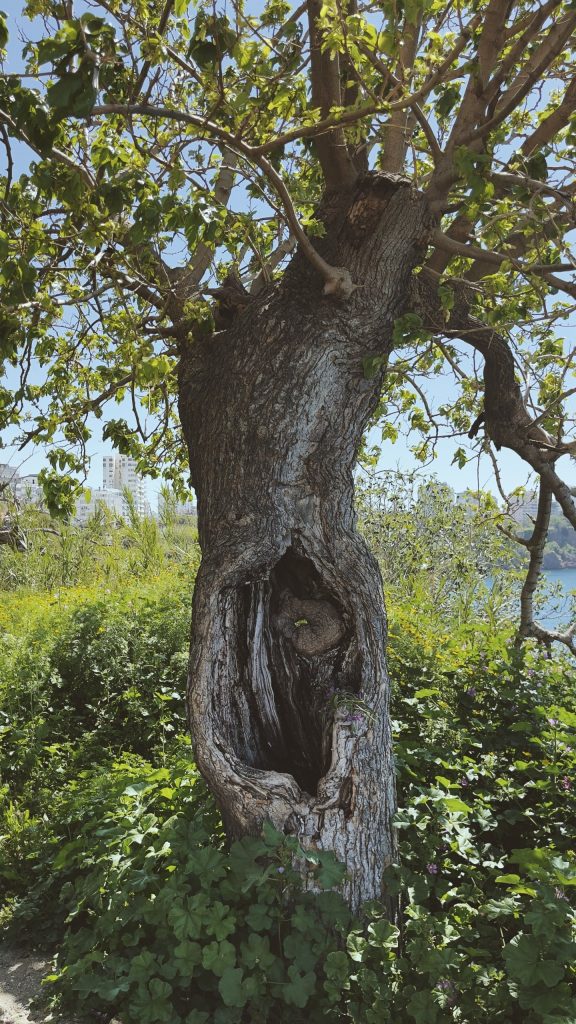
Your strength is not in the healed wound but in the open one — because there, and only there, you cannot pretend
You have heard the brave version of this sentence a hundred times: what hurt you made you stronger, your scars tell your story, you are strong at the broken places. Leave all of that outside for a moment. This piece says something stranger and, I think, truer — that whatever in you has not healed, and will not, is exactly where your ground is. I do not mean the injury once it has been dealt with and tidied into a lesson — I mean the raw place itself, the one you would rather nobody looked at too closely.
The reason is simple enough to say in one breath, though it can take a whole life to trust: at the open wound there is nothing left to pretend with. Everywhere else you can arrange yourself — choose your angle, prepare your face, tell the version that flatters you. There, no angle remains. Whatever you say from there has to be true, because nothing is available to decorate it with — and being unable to lie, even a little, turns out to be the one kind of strength that never needs performing. The rest of this piece is about beginning from there before anyone gives you permission to.
Every wounded person hears the same advice — heal first, then live — and most never get past the first part
It sounds like kindness, which is what makes it so hard to refuse. Take your time. Do the work. Get yourself well, and then — then — you can think about the relationship, the move, the book, the conversation you have been postponing for years. Your therapist says a version of it, your friend says a version of it, the articles say nothing else. Underneath the kindness hides a quiet sentence nobody says aloud: you are not ready for your own life yet.
Look at what that sentence does to a decade. The heal-first rule turns every year into a preparation for the next one — you are always nearly there, always one more course, one more breakthrough, one more quiet month away from being allowed to begin. And because no wound ever closes for good (the next section is about exactly that), the wait has no natural end. Most people never reach the second half of the advice, and not for lack of will — the first half cannot be completed, by anyone. No amount of effort satisfies a condition that was never meant to be met. Which raises the obvious question about the scars you were promised.
The scar is not the strength — no wound ever heals, it only gets covered, and the cover is exactly what makes you pretend yet again
Watch what actually happens to an old injury, physically, if you are honest about it. The skin grows back across the place and a line remains — paler, tighter, numb to the touch — and for the rest of your life you know exactly where it is. Nothing went back to the way it was before. The tissue is different tissue. What the world calls healing is this: your body laying something over the damage so that you can use the limb again. That is useful and necessary, and it is not the same as undoing anything.
The inner version works the same way, only the cover is made of story and habit. You learn which subjects to steer around, which rooms not to enter, which smile settles a conversation before it reaches the sore place. That is a skill, and it works — and its success is exactly the problem. Once the wound is covered you can behave as if it were not there, and the performance becomes your life. What gets sold to you as your strength — the scar, the story of the scar, the better person who supposedly grew around it — is a licence to go back to pretending. The open wound never offered you that option, and that is the only reason it deserves the word. It has one more property the scar cannot imitate: it refuses to let you settle.
The wound that stays open never lets you fall for the false belief that you have arrived — it keeps you on the threshold, where you naturally belong
Picture the day the story holds perfectly. The habits are automatic, the tone is steady, nobody — yourself included — can tell where the damage was. On that day you are in the most dangerous position this blog knows of: you believe you have arrived. You have crossed over, done the work, become the person on the other side of it. From that position the next wound, when it comes — and it comes — has nowhere to go. The whole arrangement depends on the damage being over. Something tears, and the story tears with it.
An open wound makes that belief impossible, and that is a mercy rather than a curse. Every morning it reminds you, without malice, that you are not on the other side of anything — you are in the middle, where you were all along, where everyone actually lives. My word for that middle is the threshold, and the threshold is not a stage you pass through on the way to somewhere better: it is the place itself, the only place a human being has ever stood. I have said this to you in a gentler key before — your gaps are what make you real — and a wound that will not close is the gap you cannot argue with. It keeps you exactly there — and that is not a punishment. It is your address. Someone spent his life working out what that address asks of a person, and gave the answer a name.
Henri Nouwen's wounded healer is not a healed person who helps — it is someone acting with their own wound wide open
Henri J. M. Nouwen was a Dutch priest who taught at Yale and Harvard and then left all of it to live in a community for people with intellectual disabilities — a man, in other words, who knew both the podium and the floor. In 1972 he published a short book whose title has since become a phrase people use without reading it: The Wounded Healer. The book's argument is not what the phrase has come to mean. It does not say that your injuries qualify you to help, as if pain were a diploma.
It says something harder: that whoever tries to help from behind a healed surface helps nobody, because nobody can reach them there — and that the only honest place to help from is the wound itself, kept open and in view. Nouwen borrowed an old story to show it: a figure waiting among the poor at the city gate, binding his wounds one at a time rather than all at once, so that he would be ready the moment he was needed. Not healed and then useful — bound up just enough to stand, and available now. He put all of it into one short book — the wounded healer's own wounds, it argues, are where the help comes from — and it is the opposite of the redemption arc you were sold. I did not learn that from the book first. I learned it the summer the stroke came.
A stroke left me with a wound that never healed and never will — and I am done waiting for it to close before I act
In the summer of 2024 I had a stroke. The long version is on the About page — what the stroke took, and what it left — but three of its consequences belong in this piece. The first is the speaking voice: it came back, and it came back different — slower, less sure of itself — and being heard through it is work I never used to have to do. The second is the one I grieve: I was a tenor in two choirs and an amateur actor, and the singing voice has not returned and, by every sign I have been given, will not. The third leaves no visible mark at all — a health anxiety that moved in that summer and has not moved out.
None of that healed, and I want to be precise about the word, because this whole piece depends on it: the body did what bodies do, the crisis passed, the routines came back — and the wound stayed exactly as open as it was, under everything. For a while I did what §1 describes. I waited. I would write again when the voice was steadier, speak to people when a sentence could be trusted to come out whole, begin the work once the anxiety let go. It did not let go. And somewhere in the second year I understood that waiting was the injury's only real power over me — that the stroke had taken a voice, but the heal-first rule was taking the years. So I stopped waiting. Not healed — it does not work like that — but done waiting. What acting from a wound means in practice is the part nobody explains, so let me.
To act from the wound is to act from where you actually stand — not from where you hoped to be by now
Starting from your real position is not a performance of the injury, and it is not a confession turned into a product. Nobody needs your wound on display, and the display would only hide you better anyway. It is something quieter and far more demanding: you begin from the exact position you are in, with the exact voice you have, today — instead of from the position you had scheduled yourself to reach first. The email goes out in the voice that stumbles. The first session happens while your hands still shake. You make the apology before you are calm enough to make it well.
Notice what this removes. It removes the hoped-for self as the one who gets to act, and with it the whole postponement. You are no longer waiting to become someone — you are acting as the person you actually are, damage included — which is, if you look closely, the only person who was ever going to act anyway. The place you hoped to be by now does not exist yet, and you cannot stand on a place that does not exist. The ground under your feet is the only ground there is. There is one more consequence, and it concerns everyone else — because what you do with a wound is never only your own business.
Your open wound is the only place where another person can actually find you — anywhere else, there is no one at home
Think about who you actually trust, and why. It is rarely the people with everything in order. It is the ones who, at some point, let you see where it hurt — and did not tidy it away afterwards. Something in you relaxed in their company, because for once you were not being managed. That is not sentiment, it is structure. When you speak from behind the story there is nobody behind the words — you have sent a representative, and people can feel the difference even when they cannot name it. Your open wound is the one place you cannot send a representative from. Whoever reaches you there, reaches you.
I have said before that grief is unbearable only when it is unshared — weep, and you weep alone — unless — and the unless has always been this: another person at the same open wound, not fixing anything, just there. People can knock on your achievements, your competence, your well-told version, and the house is empty — there is nothing in those rooms that can answer. The wound answers. It is the one door you could never quite get shut. Which is where I owe you the same honesty I am asking of you.
There are still days when I cover my wound and wait for it to close — which is very OK, as long as I notice the cover and remove it again
I would like to tell you that I begin from the injury every morning without a flicker, and that would be a lie, so I will not. There are weeks when the old rule returns under a new name. I tell myself I will record the video when the voice has a better day, write the hard email after a calmer week, finish the piece once I sound like me — excellent reasons, every one of them, and all of them the same rule: heal first. That is the old rule at the wheel, quietly. I do not always see it at once, and sometimes a week goes by before I realise I have been waiting again.
And the slip does no harm at all, provided I notice it — and the moment I do, I take the cover off again and go back to acting from the injury as it is, voice and all. That is all there is on my side, and it is more than it sounds. Walk with me means no more and no less than this — one wounded person, within reach of another. Your unhealed wound is your strength. Not the healed one you were promised, not the scar with the good story — the open one, the one you have today, the one you are already speaking from.